
10 hours ago
UFAZ Faculty Member’s Scientific Article Published in an International Journal
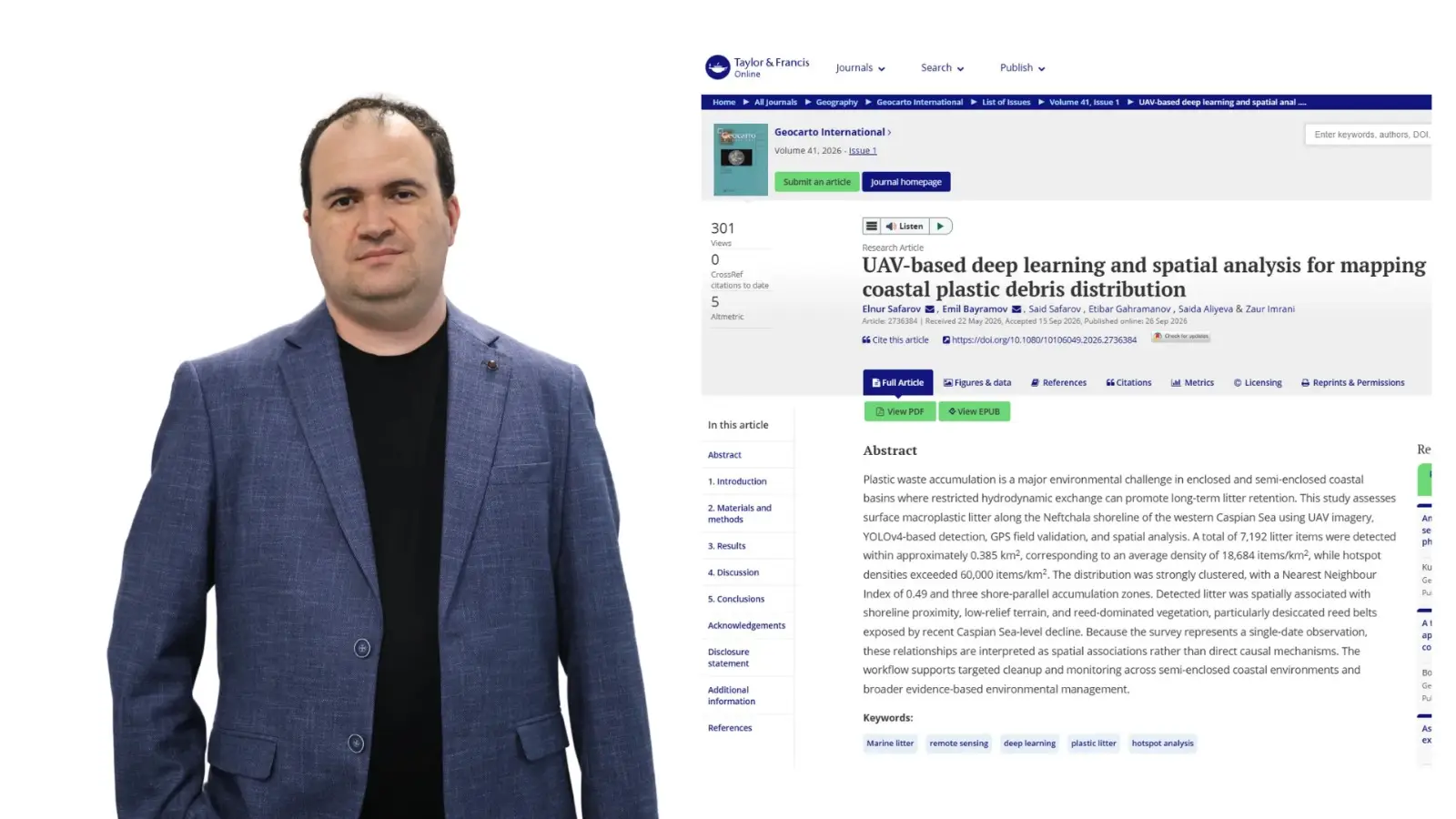
A scientific article titled “UAV-Based Deep Learning and Spatial Analysis for Mapping Coastal Plastic Debris Distribution”, co-authored by Elnur Safarov, Coordinator of the Water Resources and Management program at the French-Azerbaijani University (UFAZ), has been published in the international scientific journal Geocarto International.
Published by Taylor & Francis, Geocarto International is a Q1 journal indexed in Scopus. It ranks in the 95th percentile, placing it among the top 5% of journals in the field of Geography, Planning and Development. The journal has a CiteScore of 10.8 and an Impact Factor of 3.9.
The study focuses on mapping the distribution of plastic waste along the Neftchala coastline of the Caspian Sea. The research combines high-resolution imagery captured by unmanned aerial vehicles (UAVs), the YOLOv4 deep learning model, GPS-based field observations, and spatial analysis using geographic information systems (GIS).
The study identified 7,192 plastic litter items across an area of approximately 0.385 km². The analysis revealed that the litter was unevenly distributed, with waste concentrated in specific areas. Three major accumulation hotspots parallel to the shoreline were identified, with local densities exceeding 60,000 items per square kilometre.
The findings also revealed spatial associations between litter distribution and proximity to the shoreline, coastal terrain characteristics, and reed-dominated vegetation. In particular, dried reed belts exposed by the ongoing decline in the Caspian Sea level may play a role in the accumulation of plastic waste.
The study demonstrates how UAV-based remote sensing, artificial intelligence, field observations, and GIS-based spatial analysis can be combined to assess coastal plastic pollution more accurately. The proposed approach offers practical opportunities to identify priority areas for cleanup, support targeted waste removal, and monitor changes in coastal pollution over time.
Read the full article here: UAV-based deep learning and spatial analysis for mapping coastal plastic debris distribution