1 day, 8 hours ago
UFAZ Teacher's Article Published in Q1-Ranked Sustainability Journal

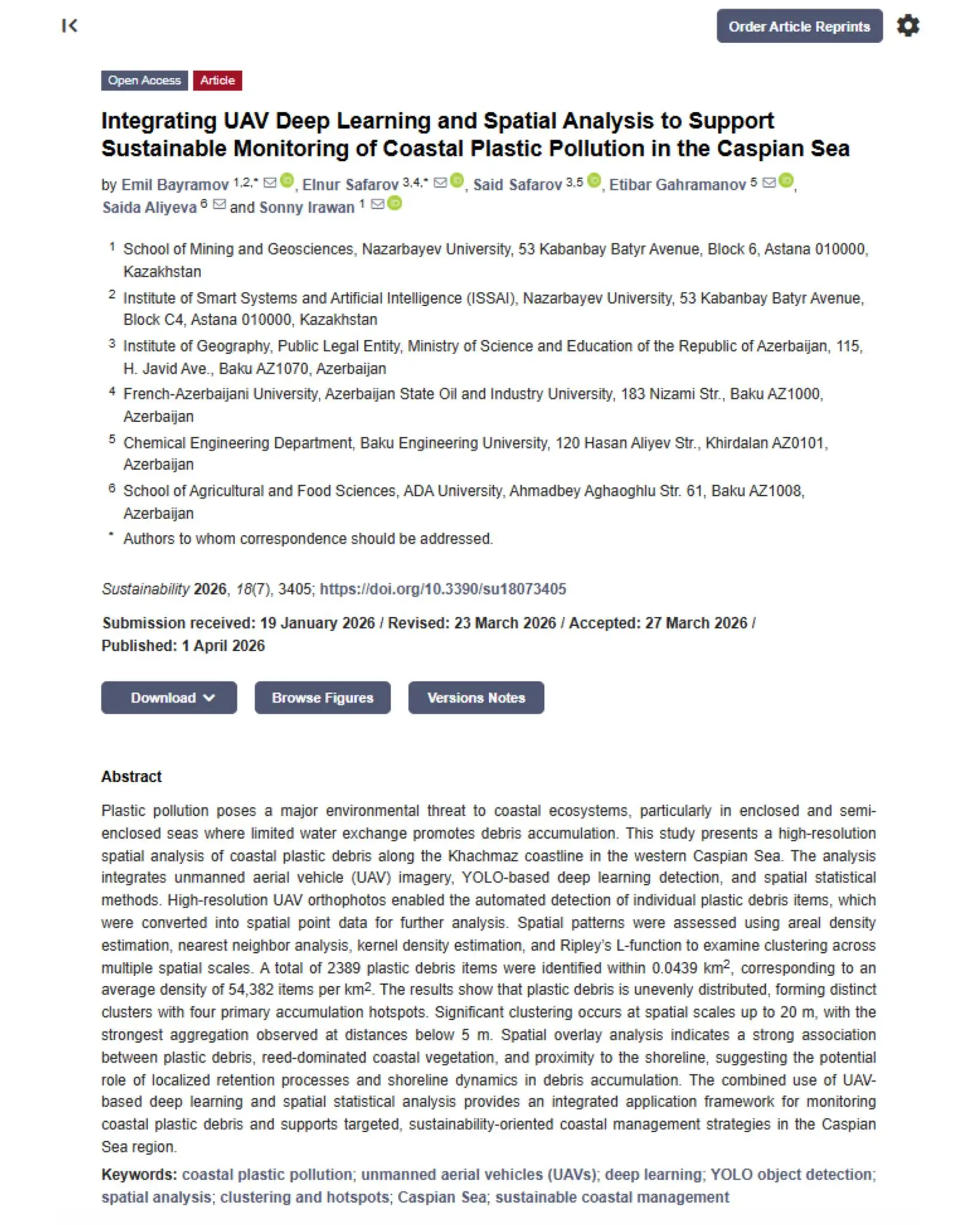
The article titled “Integrating UAV Deep Learning and Spatial Analysis to Support Sustainable Monitoring of Coastal Plastic Pollution in the Caspian Sea,” co-authored by Dr. Elnur Safarov, Program Coordinator for Water Resources and Management at the French-Azerbaijani University (UFAZ), has been published in the prestigious journal Sustainability. This publication is a Q1-ranked, high-impact scientific journal (IF: 3.3; Cite Score: 7.7) managed by MDPI and positioned within the top 10% of Scopus indexed titles in environmental and sustainability sciences.
The research presents an innovative and integrated methodology for monitoring plastic pollution along the Khachmaz coastline of the Caspian Sea. By combining high-quality imagery obtained from UAVs with YOLO deep learning algorithms, the authors have developed an automated detection system for debris in the coastal zone. This approach offers significant advantages in terms of both time and accuracy compared to traditional visual observation methods.
The key scientific findings highlighted in the article identified four primary hotspots where plastic waste accumulates along the Khachmaz shoreline. Spatial statistical analyses demonstrate that waste is specifically clustered at scales of less than 5 meters. These clusters are directly associated with shoreline dynamics and areas dominated by reed vegetation, which helps in understanding the mechanisms of how waste moves from the sea to land and its retention there.
The practical significance of the research lies in the creation of a sustainable ecological monitoring model for enclosed water basins like the Caspian Sea. The model proposed by Dr. Elnur Safarov and the research team is reproducible and can be applied to other coastal regions, serving as a scientific basis for developing strategies to combat plastic pollution.
This study is considered a significant step in the integration of modern artificial intelligence technologies into the solution of environmental problems and aims to contribute to energy transition and ecological sustainability strategies in the region.
You can read the full text of the article at the following link: https://www.mdpi.com/2071-1050/18/7/3405